Concept buildSelf-initiated, not client work. The figures below are design targets we set ourselves, not results delivered for a customer.
PROVENANCELEDGER
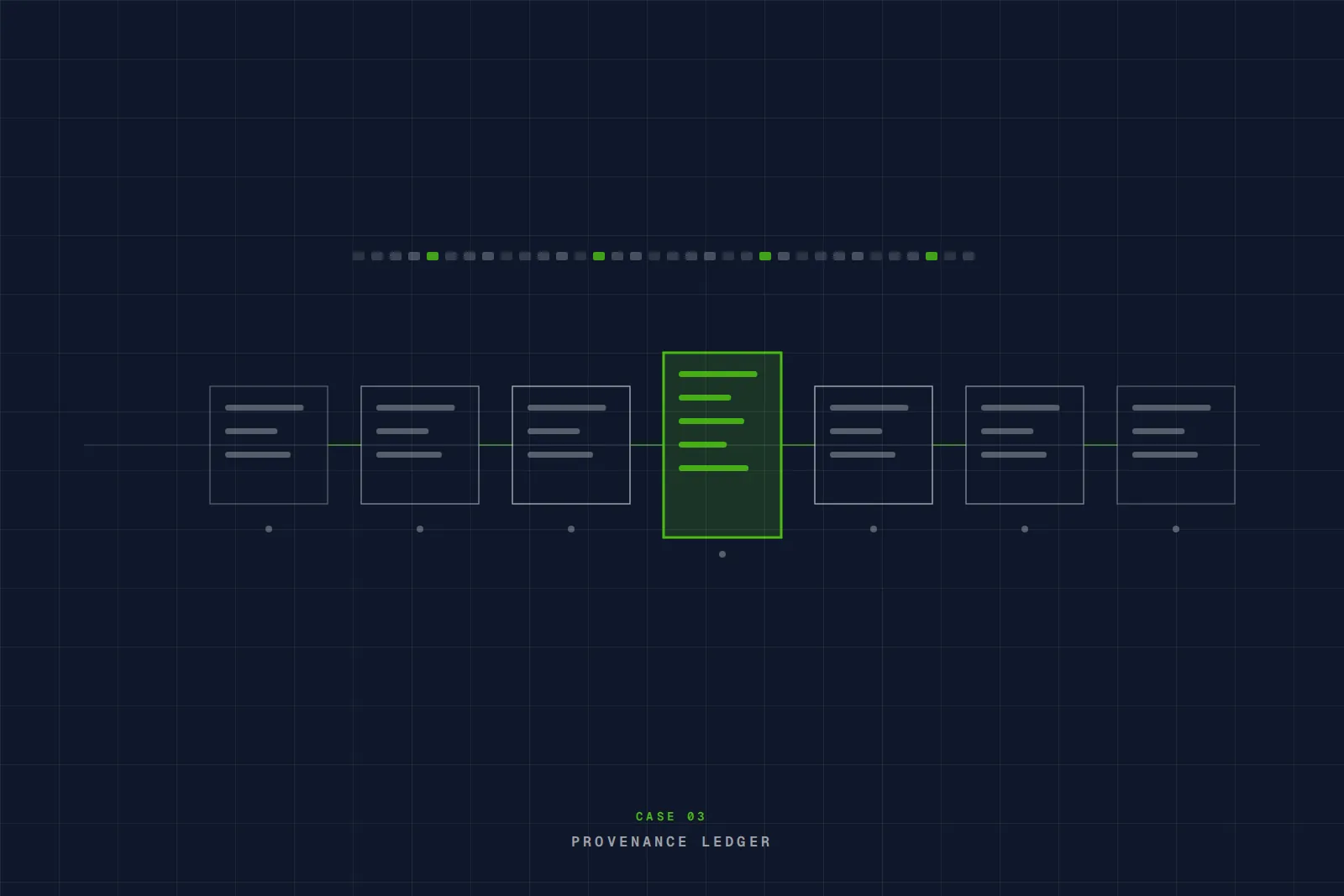
A self-initiated concept build by Windson — Supply Chain Blockchain Platform, on Solidity, Polygon, Next.js, built to test the approach rather than for a client.
The brief we set ourselves: certificates of origin moving between five parties as PDFs and spreadsheets, where every handoff is a chance to lose the thread. Disputes take days because nobody can prove which version of a document is authoritative, and an audit means reconstructing a paper trail out of email. We wanted to find out how much of that a permissioned chain actually fixes — and how much it just moves.
We put the record on a permissioned Polygon chain. Each custody event is written as an event log; documents are hashed on-chain while the files themselves stay in the owner's storage, so provenance is provable without publishing commercial paperwork. Contracts are upgradeable and were audited before deployment. A Next.js console reads chain state and presents it as an ordinary timeline, so staff never touch a wallet or a block explorer.
A shared record no single party can quietly edit, read by people who never need to know it is a blockchain.
SYSTEM DELIVERABLES
What we actually built, and why each piece had to exist. Nothing here is a mockup — the concept was taken far enough to prove the approach works.
Custody Smart Contracts
Upgradeable Solidity contracts recording each transfer as an immutable event, with role-based write access per participant.
Document Hashing Pipeline
Files stay in the owner's storage and only their hashes reach the chain, so provenance is provable without putting commercial documents on a ledger.
Operations Console
A Next.js interface that reads chain state and renders it as a plain timeline, keeping wallets and block explorers out of the daily workflow.